
Science Gears Pty Ltd
Electrochemistry Accessories · 🇦🇺 AU
View supplier storefront →
Verified
5+Yrs
0Orders
NewRating
Click to zoom
Science Gears Pty Ltd · Electrochemistry Accessories
Hg/Hg2SO4 Reference Electrode
0.0(0 reviews)·✓ 0+ verified orders
WHOLESALE UNIT PRICE
—
Bulk pricing available
Quantity
1
🔒Escrow Protected
🏭Factory Verified
🚢Ships Globally
🇦🇺
Ships from
Queensland, Australia
⏱️
Lead time
3–7 days (AUS) · 7–21 days (INT)
💳
Payment
T/T · PayPal · Escrow · L/C
📜
Certifications
—
🌐
Export to
200+ countries · All major markets
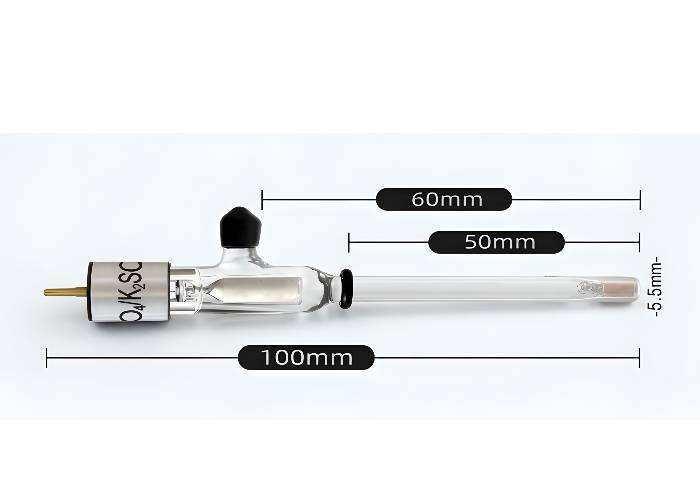
Product Descriptio Core Design Elements The electrode features a glass body construction with a microporous ceramic filter junction that ensures steady electrolyte flow while maintaining measurement integrity. The internal system consists of metallic mercury in contact with mercurous sulfate (Hg2SO4), creating the fundamental electrochemical reaction: Hg2SO4(s) + 2e⁻ ⟷ 2Hg(l) + SO4²⁻ This reaction establishes a standard electrode potential of +0.615 to +0.674 V versus Normal Hydrogen Electrode (NHE) at 25°C, with reported values ranging from +0.62 to +0.66 V depending on the specific sulfate electrolyte concentration. Physical Specifications Tube diameter : 6-12 mm (varies by model) Effective length : 70-150 mm Filling solution : Saturated K2SO4 or defined H2SO4 Potential stability : <5 mV Operating temperature : 0-40°C (standard models) up to 100°C (specialized versions) Junction type : Porous ceramic frit or electroporous KT glass Key Performance Advantages Superior Chemical Robustness The Hg/Hg2SO4 reference electrode excels in chloride-rich environments where traditional Ag/AgCl electrodes may experience performance degradation. Its resistance to chloride poisoning makes it the preferred choice for corrosion testing, electroplating studies, and lead-acid battery applications. Exceptional Stability & Low Drift This reference system delivers outstanding potential stability with minimal drift over extended measurement periods. The electrode recovers quickly from small temperature excursions, maintaining measurement accuracy even under challenging operational conditions. Optimized Junction Performance The porous frit junction design provides steady electrolyte flow while minimizing liquid junction potentials. This configuration ensures consistent ionic conductivity and reduces measurement uncertainty across various experimental conditions. Primary Applications Corrosion Testing & Analysis The electrode serves as the industry standard for corrosion studies in chloride-containing media, providing reliable reference potentials for materials evaluation, protective coating assessment, and infrastructure monitoring applications. Lead-Acid Battery Research Battery testing and maintenance represent major application areas, particularly for measuring half-cell potentials in lead-acid systems. The electrode's compatibility with sulfuric acid electrolytes makes it indispensable for battery performance evaluation and cycle life studies. Electrochemical Analysis Research applications include electroanalysis, potentiometric titrations, and fundamental electrochemistry where mercury handling protocols are acceptable and chloride contamination must be avoided. Acidic Electrodeposition The electrode proves essential for electroplating and electrodeposition studies in acidic media, enabling precise potential control during metal deposition processes while avoiding chloride interference. Operational Considerations Maintenance Requirements Proper electrode care involves maintaining saturated sulfate fill levels , preventing bubble formation in the electrolyte, and periodic verification against standard references. The filling solution should retain a few crystals to ensure sulfate saturation. Safety & Handling Mercury handling and disposal procedures apply to all operations involving this electrode type. Users must consult institutional safety policies and follow established protocols for mercury-containing equipment. Temperature Management Due to the electrode's negative temperature coefficient and thermal hysteresis , temperature fluctuations should be minimized during measurements. Advanced configurations may include extended salt bridge tubes to isolate the electrode from temperature variations. Comparative Advantages Versus Ag/AgCl Electrodes The Hg/Hg2SO4 system offers superior chloride resistance and maintains stability in sulfate-rich environments where Ag/AgCl electrodes may experience contamination issues. Versus Calomel Electrodes Compared to saturated calomel electrodes, the Hg/Hg2SO4 provides enhanced stability in sulfate-containing solutions and avoids chloride-related complications in sensitive analytical procedures. Environmental Compatibility The electrode's sulfate-based internal solution makes it ideally suited for applications in sulfuric acid media, lead-acid battery systems, and other sulfate-containing environments where competing reference electrodes may prove inadequate. Quality Assurance & Standards Science Gears' Hg/Hg2SO4 reference electrodes are manufactured using reagent-grade mercury sulfate and high-purity electrolyte solutions. Each electrode undergoes rigorous quality testing to ensure potential stability, junction integrity, and long-term reliability . The electrodes feature traceable identification and include comprehensive documentation with safety data sheets. The electrode represents an essential tool for researchers and analysts requiring dependable reference potentials
Technical specifications
| Model / SKU | SCIGEAR00050 |