
Science Gears Pty Ltd
Potentiostats / Galvanostats · 🇦🇺 AU
View supplier storefront →
Verified
5+Yrs
0Orders
NewRating
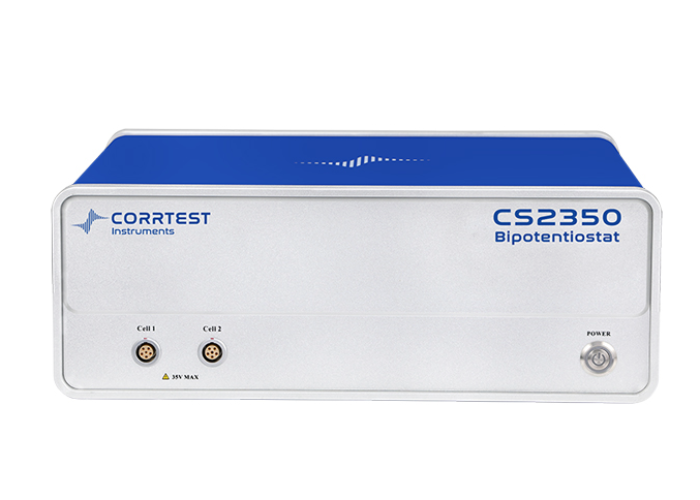
1 / 3
Click to zoom
Science Gears Pty Ltd · Potentiostats / Galvanostats
CS2350M Bipotentiostat (2-channel, with EIS)
0.0(0 reviews)·✓ 0+ verified orders
WHOLESALE UNIT PRICE
—
Bulk pricing available
Quantity
1
🔒Escrow Protected
🏭Factory Verified
🚢Ships Globally
🇦🇺
Ships from
Queensland, Australia
⏱️
Lead time
3–7 days (AUS) · 7–21 days (INT)
💳
Payment
T/T · PayPal · Escrow · L/C
📜
Certifications
—
🌐
Export to
200+ countries · All major markets
CS2350M Bipotentiostat (2-channel, with EIS) Highlights The CS2350M is a dual-channel potentiostat/galvanostat system, purpose-built for advanced electrochemical research. Each channel is fully independent and includes its own EIS module, enabling true simultaneous measurements or coordinated dual-working electrode experiments such as RRDE or hydrogen diffusion studies. Its Ethernet connectivity ensures stable high-speed data transfer, and the software is engineered for intuitive setup and advanced data analysis. Designed for researchers requiring flexible, powerful, and affordable electrochemical instrumentation, the CS2350M offers exceptional value at a fraction of the cost of comparable systems. Key Features True 2-channel design with complete electrical separation EIS capability in both channels for full-spectrum impedance analysis Compatible with any commercial RRDE rotator system Enables hydrogen diffusion testing with H-cell configurations Full channel independence allows simultaneous experiments on separate cells Floating mode support for autoclave and in-ground electrochemical monitoring Cost-effective with high-end functionality Applications Electrosynthesis, electrodeposition, electroplating, electrolysis ORR, OER, HER, CO₂ reduction studies Lithium-ion battery, fuel cell, solar cell, supercapacitor research Advanced material characterization and sensor development Corrosion evaluation and inhibitor screening Water treatment, coating stability, cathodic protection testing Included Items CS2350M Bipotentiostat unit ×1 CS Studio software ×1 Power cable ×1 Ethernet cable ×1 Cell cables ×4 Dummy cells (1kΩ||100µF) ×2 Highlighted Techniques Rotating Ring-Disk Electrode (RRDE): Enables intermediate detection at the ring while controlling disk polarization, ideal for ORR studies. Hydrogen Diffusion Test (HDT): Supports H-cell measurements for evaluating hydrogen permeation through metal surfaces. Electrochemical Impedance Spectroscopy (EIS): Uses advanced algorithms for high-resolution impedance analysis, even in high-resistance systems. Voltammetry: Full suite including CV, LSV, SWV, DPV, NPV, SCV, stripping voltammetry with integrated peak analysis tools. Polarization Curves: Automatic Tafel fitting for evaluating corrosion characteristics and inhibitor efficiency. Electrochemical Noise: For localized corrosion studies such as pitting, crevice, and stress corrosion. Software Capabilities Peak analysis (area, height, position) for CV and other voltammetry techniques Cycle-by-cycle view and export for in-depth review Butler-Volmer equation fitting for Tafel and corrosion parameters Battery test analytics (capacity, charge/discharge energy and efficiency) Real-time data saving with automatic recovery after power loss Batch automation via combination test sequences SDK/API available for custom method integration Hydrogen Diffusion Test (HDT) The CS2350M bipotentiostat can be used in conjunction with H-cells to measure the current associated with hydrogen charging at the cathode and hydrogen atom oxidation at the anode. This setup enables the calculation of the hydrogen diffusion coefficient in metals and the measurement of hydrogen flux. Technical Advantages 1. Impedance (EIS) The Corrtest potentiostat utilizes a correlation integral algorithm along with a dual-channel over-sampling technique, providing robust resistance to interference. This makes it highly effective for EIS measurements in high-impedance systems (>10⁹Ω), such as coatings, concrete, and similar materials. EIS of AA6063 Al alloy in Ce 3+ containing 3% NaCl solution 2. Polarization Curve A Tafel plot can be generated, allowing users to set the anodic reversal current (the current at which the passivation film breaks down) on the cyclic polarization curve. This helps in determining the material's pitting potential and protection potential, which are crucial for evaluating its susceptibility to intergranular corrosion. The software employs non-linear fitting to analyze the polarization curve, providing a rapid assessment of the material's corrosion resistance and the effectiveness of inhibitors. Polarization curve of Ti-based amorphous alloy & stainless steel in 3%NaCl solution 3. Voltammetry The system supports various voltammetry techniques, including Linear Sweep Voltammetry (LSV), Cyclic Voltammetry (CV), Square Wave Voltammetry (SWV), Differential Pulse Voltammetry (DPV), Normal Pulse Voltammetry (NPV), Alternating Current Voltammetry (ACV), and Stripping Voltammetry. It also integrates the calculation of peak areas, peak currents, and standard curve analysis for comprehensive data evaluation. LSV: mesoporous carbon material in 0.1M KOH CV of PPy supercapacitor in 0.5 mol/L H 2 SO 4 4. Electrochemical Noise The system utilizes a high-resistance follower and a zero-resistance ammeter to measure natural fluctuations in potential and current within corrosion systems. This technique is effecti
Technical specifications
| Weight | 8 kg |
| Software | Windows 10/11 compatible |
| Bandwidth | 8-decade frequency range, auto/manual setting |
| Interface | Ethernet |
| Dimensions | 36.5 cm × 30.5 cm × 16 cm |
| Model / SKU | SCIGEAR00131 |
| Current Range | ±1 A |
| Potential Range | ±10 V (customizable to ±12 V) |
| Compliance Voltage | ±21 V |
| Current Resolution | 1 pA |
| EIS Frequency Range | 10 µHz to 1 MHz |
| Potential Resolution | 1 µV (≤10 Hz), 3 µV (>10 Hz) |
| Electrode Configuration | 2-, 3-, or 4-electrode system |